Wands · Ten
Ten of Wands
overload · ownership · carrying
Overload that was assembled one reasonable yes at a time.
- Suit
- Wands
- Element
- Fire
- Reversed
- putting it down
What the card shows
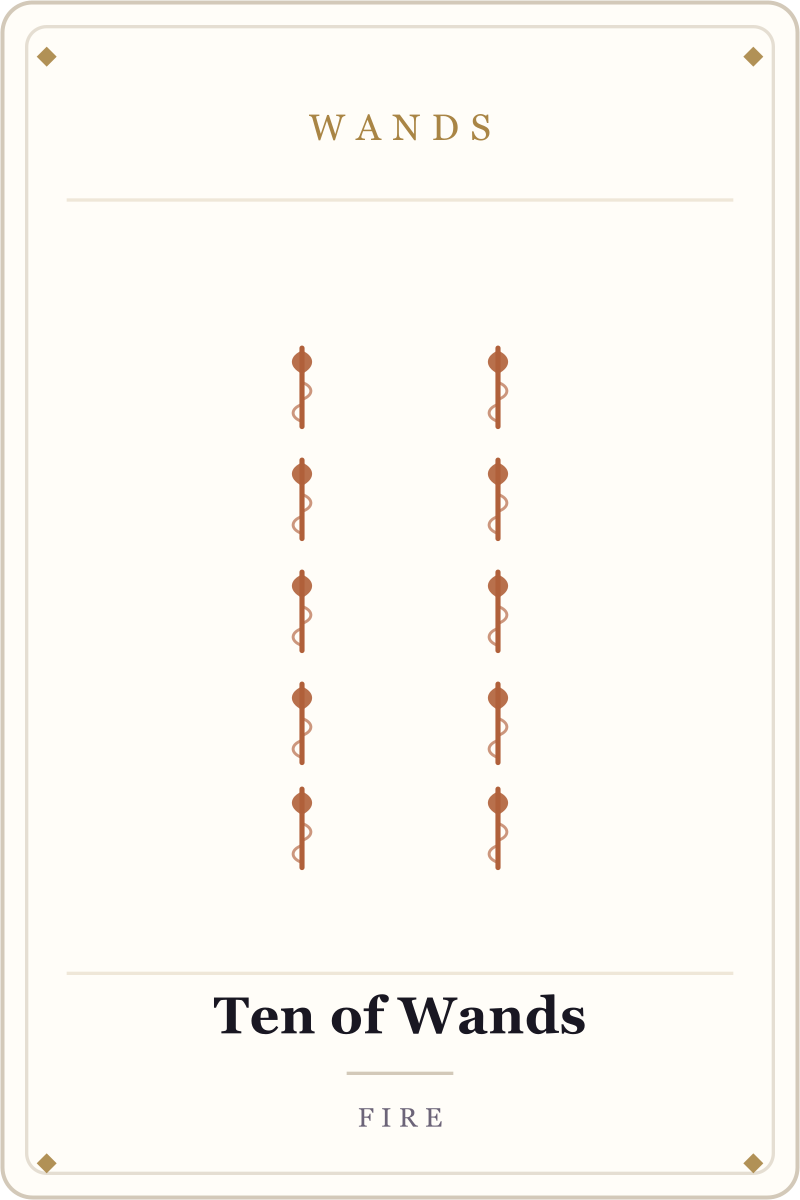
A figure carries ten wands in a bundle so wide it hides his face. He walks toward a town in the distance, and the load leans forward. The road is flat; the weight is the whole problem.
Upright
Overload that was assembled one reasonable yes at a time. The card is not about capacity, it is about ownership: how much of this is actually yours to carry.
Reversed
The load is being put down, or it is being carried with resentment rather than purpose. Either way, the card asks for a list of what could be handed over.
What it is not
Often read as success. It is the load that success accumulated, and the card is about ownership rather than capacity.
Where it turns up
A quarter with three roles, a family where you are the coordinator, a freelance month with no unpaid hours. It also shows up in the sentence "it is easier if I do it".
What to do with it
Give one item on the list to someone else this week.
A ten-minute practice
List everything you are carrying. Mark each item as mine, borrowed, or inherited. Hand one borrowed item back this week, in writing. The exercise is to see how much of the weight was never yours.
Three questions to sit with
- Which of these did you actually agree to?
- What would break if you put it down?
- Who could carry one of these instead?
In a three-card spread
- Past
- The Ten of Wands in the past position describes what shaped the question, not what caused it.
- Present
- In the present, the card is the question as it stands today. Read it slowly, and notice what you resist.
- Future
- In the future position it is a direction, not an event: what the situation is turning into if nothing changes.
Ten of Wands is a reflective prompt, not a prediction. Nothing here is medical, legal or financial advice, and no card is a promise about what will happen.